
Submissions
Online Submissions
To learn more about our submission process and other frequently asked questions, see below.
Already have a Username/Password?
Need a Username/Password?
Registration and login are required to submit items online and to check the status of current submissions.

New Submission Process
To save time for everyone, the initial submission of your manuscript no longer needs to be formatted to any particular style. Reference citations, however, should adhere to the name-year (Harvard) system, with references being alphabetized by author (see “Formatting a Manuscript” below for details). Later, If your paper is accepted, you will be asked to upload a version that meets our journal’s specifications and formatting requirements.
After answering some questions about your paper, simply upload a double-spaced, line-numbered, anonymized pdf of your paper. The PDF will be sent directly to reviewers. Therefore, to ensure blind peer review, it is important that your names are not included in the PDF.
(Note: re-submissions of manuscripts follow the procedures of the initial submission. If your initial submission required rich-text format files, those files will also be needed for re-submission.)
Initial Submission Guidelines
First, please ensure email from @ecologyandsociety.org is not blocked by your email service provider and that the domain is marked as “not spam” in your email client. We must be able to communicate with you.
You will be guided through the initial submission process.
- Step 1. Answer the questions provided.
- Step 2. Enter authors’ names and details.
- Step 3. Enter title, abstract, keywords, and acknowledgments details
- Step 4. Upload a double-spaced, anonymized, and line-numbered pdf of your manuscript (include abstract, graphs, tables, equations, and appendices).
- Step 5. Confirm and finalize your submission.
If you have any difficulties with this process, contact the managing editor by email managing_editor@ecologyandsociety.org.
Post-Acceptance Guidelines for New, PDF-Only Submissions
After a paper is accepted, the corresponding author will be invited to upload all relevant files for their article for copy editing. The corresponding author should log in, navigate to the article, then go to the “Upload documents for copy editing” tab.
Step 1: Upload an .rtf file of your manuscript, from INTRODUCTION through to the end of LITERATURE CITED. This file should not include: embedded images, title, abstract, keywords, acknowledgments, tables, figures, or author information. Your upload should, however, include placeholders for any equations (e.g., “<eqn1>”). Equation placeholders should be on their own line.
Step 2: Upload attachments (tables, figure files, equations, and appendices) one by one by following the links and instructions on the page. For each attachment, add a caption in the field provided.
Step 3: Confirm that all files have been uploaded successfully and are presenting correctly by reviewing the html copyedit galley.
Step 4: Verify that you have completed the uploading of files by selecting “Submission upload complete.”
Old Submission Procedures
The old submission process is divided into the following six steps. Detailed instructions for each step can be found on the submission pages.
- Step 1: Specify the manuscript type, complete the checklist, enter your “Data and Code Availability Statement,” submit a cover letter, and if applicable, assign your manuscript to a Special Feature.
- Step 2: Specify authors’ information.
- Authors must be individuals, not groups or corporations.
- Authors’ names and affiliations will appear in the published paper the way you enter them. Please take the time to ensure your coauthors’ names and affiliations are correct.
- Affiliations may include department, institution, city, and/or country. None are required.
- Enter mail or street addresses in the contact information box. Addresses are not required.
- Step 3: Enter the Title, Abstract, Keywords/phrases, and Acknowledgments.
- All must be text only.
- Step 4: Upload the body of the manuscript – text only, as .rtf file – from “INTRODUCTION” through to the end of the “LITERATURE CITED.”
- Title, abstract, keywords, and acknowledgments have already been entered above. Please do not include these elements in the rtf file.
- Figures, tables, appendices, equations, and all other attachments will be uploaded in Step 5.
- Step 5: Specify the list of attachments and upload those attachments (tables, figures, equations, appendices).
- Step 6: Final verification of the manuscript.
Note: The author interface for each of these steps includes details on how to enter the information required.
1. Organizing your submission
(For the new, PDF-only submission process, many of the requirements below will be applicable only after your paper has been accepted for publication.)
Please divide your manuscript into the following elements and save as the following file types:
- Article body, from INTRODUCTION to the end of LITERATURE CITED (rich-text format)
- Tables (each table should be an individual file: rich-text format)
- Figures (each figure should be an individual image file: GIF, PNG, or JPG)
- Equations (each equation should be an individual image file: GIF, PNG, or JPG — GIF is best for equations)
- Appendices (PDF for text, tables, and figures; other file types are accepted for models, spreadsheets, etc.)
2. Title, Abstract, Keywords/phrases, and Acknowledgments
Note: for both old and new submission procedures, these steps are completed as part of the initial submission.
Type (or cut and paste) these elements directly into the fields provided in the submission platform.
Title
- The title should be in sentence case (only the first word and proper nouns should be capitalized).
- Avoid abbreviations.
- Example: Resilience in urban and rural Mexican small-scale fisheries
Abstract
- Abstracts should generally be fewer than 300 words.
- They should not contain citations.
- Avoid abbreviations – if abbreviations are used they must be spelled out at first instance.
Keywords/phrases
- List keywords alphabetically.
- Separate each keyword with a semicolon.
Acknowledgments
- Type (or copy and paste) this statement directly into the field provided.
3. Body of the manuscript
This file should contain all article text from INTRODUCTION through to the end of LITERATURE CITED. No abstract, figures, or tables should be present in the body of the manuscript.
Note: for the new, PDF-only submission process, the formatting specifications detailed below are required only post acceptance.
Headings and subheadings
- All headings must be placed on a line by themselves.
Main headings
- The following standard headings should be used preferentially (if appropriate):
- INTRODUCTION, METHODS, RESULTS, DISCUSSION, CONCLUSION, LITERATURE CITED
- Other headings are permissible.
- Main headings should be in all capitals, centered on a line by themselves.
- The heading introducing references must be LITERATURE CITED (in all capitals).
Secondary headings
- Secondary headings should be in bold.
- These headings should be left-justified on a line by themselves.
- Use sentence case (lowercase except for the initial letter of the first word and proper nouns).
- Example: General characteristics of movement
Tertiary headings
- Tertiary headings should be italicized.
- These headings should be left-justified on a line by themselves.
- Use sentence case (lowercase except for the initial letter of the first word and proper nouns).
- Example: Field study and simulation model
Equations
In the rtf file (for the main article body), designate the location of each equation by inserting tags <eqn#> where the equation should appear, where # is replaced by the number of the equation in your article (e.g., <eqn1>). Place these tags on their own line.
Upload each equation as a separate graphic file named eqn#.gif, where # corresponds to the tags inserted into the body of the manuscript.
An equation may be presented any number of times within an article by inserting the appropriate tag in the manuscript in multiple locations.
Text boxes
To set content apart in a text box, place in the body of the manuscript the following tags: <txt#> at the beginning and </txt#> at the end of the content (where # is replaced by the number of the text box in your article). Example: <txt1>.
Details of Style
General guidance
- The Council of Science Editors (CSE) Style Guide is recommended for details of style.
- Manuscripts are currently accepted in English only.
- Write with precision, clarity, and economy: use the active voice and first-person whenever appropriate.
- Use American spelling (e.g., behavior, not behaviour) except when quoting or in citations.
Spacing and fonts
- Single-space all material.
- Separate paragraphs with a blank line.
- Use 12-point font (preferably Times New Roman).
Underlining and italicization
- Italicize scientific names and symbols for all variables and constants except Greek letters.
- Symbols in illustrations should be in italics to match the text.
- Italics, bold, or underlining should not be used for emphasis.
- Do not underline text.
Capitalization
For common names of birds, follow the Ornithological Societies of North America style (AOU checklist), with initial capital letters. Example: Black-throated Green Warbler. For all non-avian taxa, use lowercase for common names.
Footnotes
Avoid footnotes in the body of the manuscript; most footnote material can be incorporated into the text for the benefit of readers and editors.
Table footnotes are acceptable. For table footnote citations, use the following symbols (in order): †, ‡, §, |, ¶, #, ††, ‡‡, §§, ||, ¶¶, ##. Note: the asterisk is reserved for probability values.
Units
Use the International System of Units (Systeme Internationale: SI) for measurements. Consult Standard Practice for Use of the International System of Units (ASTM Standard E-380-93) for guidance on unit conversions, style, and usage. When preparing text and figures, note in particular:
- SI requires the use of the terms mass or force rather than weight;
- use the solidus (/); for two or more units in a denominator, use negative exponents; and
- use a capital L as the symbol for liter.
Statistics
Use leading zeroes with all numbers <1, including probability values (e.g., P < 0.001). For every significant F statistic reported, provide two df values (numerator and denominator). Whenever possible, indicate the year and version number of the statistical software used.
Website (html) links
Authors may include links to other Internet resources in their article [e.g., the Breeding Bird Survey (http://www.mbr-pwrc.usgs.gov/bbs/bbs.html)]. When inserting a reference to a webpage, please include the http:// portion of the address.
References and Literature Cited
In-text citations
- Include author surname and year of publication (Smith 2000).
- Separate two references with a comma (Smith 2000, Green 2002).
- List reference citations chronologically (Smith 2000, Green 2002, Brown 2012).
- If a reference has two authors, cite both names; if it has three or more authors, cite the first author followed by et al. (Smith and Brown 2000, Smith et al. 2012).
- If, within the same parenthetical citation, the same author appears in two different years, name the author only once (Smith 2000, 2012, Brown 2013).
- If, within the article, the same author-year could refer to multiple references, distinguish the references with letters after the year (Smith 2000a, 2000b).
- Direct quotes should include the date followed by page number (Smith 2000:197).
- Second-hand references are permitted (Smith 2000, as cited in Brown 2005). Note: in this example, Smith 2000 should not appear in the Literature Cited section.
- Unpublished material is not allowed in the Literature Cited but may be cited in the text as personal observations (by an author of the present paper); personal communications (from others); or unpublished data, manuscript, or report. Provide authors’ names and initials for all unpublished data, manuscripts, and reports in the text of the paper.
Literature Cited
- In general, use Harvard Referencing System for all references.
- Each citation in the text must be included in the Literature Cited section.
- Every reference in the Literature Cited must be referred to in the text.
- The list should conform in sequencing and punctuation to that found in recent issues of Ecology and Society.
- Do not include italics anywhere in referencing or in the Literature Cited.
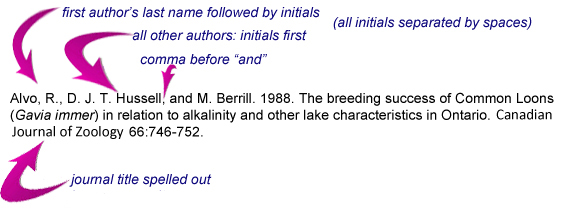
- All journal titles should be spelled out completely.
- In the titles of articles, the spellings of all words should agree with those used in the original publication.
- Provide the publisher’s name and location when you cite symposia or conference proceedings; distinguish between the conference date and the publication date if both are given.
- Links to online, freely available articles are permitted. Please use the following format:
http://CRAN.R-project.org/package=lme4 - Do not include links to password-protected websites or an author’s website. Exceptions to this rule include links to Birds of North America species accounts and links to authors’ websites that post a software program that is not available by any other means and is integral to the paper.
- Insert spaces between author’s initials.
- Last name appears first for first author; initial(s) first for subsequent authors.
- Books and conference proceedings must include publisher information: name, city, state or province (if pertinent), and country.
- Conference proceedings must include the city, state/province, country, and year in which the conference was held. Conference dates are typically included, although not required. The editor(s) of proceedings should be included, if possible.
- Journal articles in press should include the volume number of the journal even if the page range is not known.
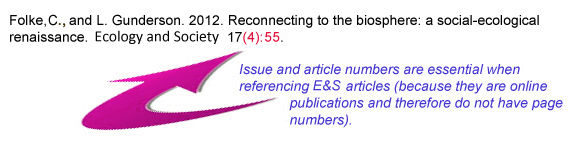
Example, citing an Ecology and Society article:
Example, citing an article from another journal:
4. Attachments (tables, figures, equations, and appendices)
All tables, figures, appendices, and databases constitute attachments to the body of the manuscript. As such, they must be submitted as separate files. During the submission process you will be required to select your attachment type from a drop-down list, and then type or paste its associated caption. These steps are repeated for each attachment. You will then upload the attachment files, and our software will generate a web page for each attachment based on the file names and captions provided. Do not include captions or titles within the table or figure files themselves.
Please see the Equations section below for information on how to format equations.
Tables
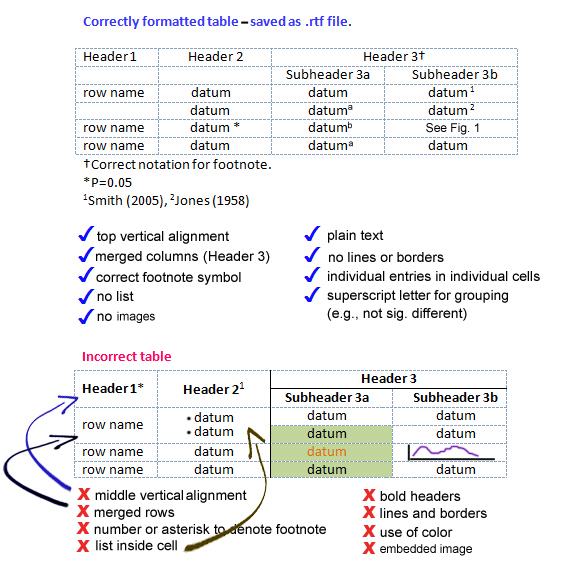
- Each table should be saved separately as an .rtf file.
- The table’s caption is entered separately and should not appear in the table.
- All text in tables should be single spaced.
- Row and column entries should be separated by cell divisions by using the table function in the word processing software.
(Using tabs, spaces, or blank lines to separate information will not be acceptable.) - Do not use horizontal or vertical lines (borders) to separate cells.
- No images are permitted within tables.
- Use regular font in column and row headings (no bold or italics), and no color.
- Do not merge rows; however, merging across columns is acceptable.
- Do not use bulleted or numbered lists.
- Asterisks are reserved to denote levels of significance, not for footnotes
- The footnote symbols should be in the order: †, ‡, §, |, ¶ , #, and then doubled symbols. (See CSE Style Manual).
- Do not include information in tables that is not discussed in the text of the manuscript.
Table examples:
Figures
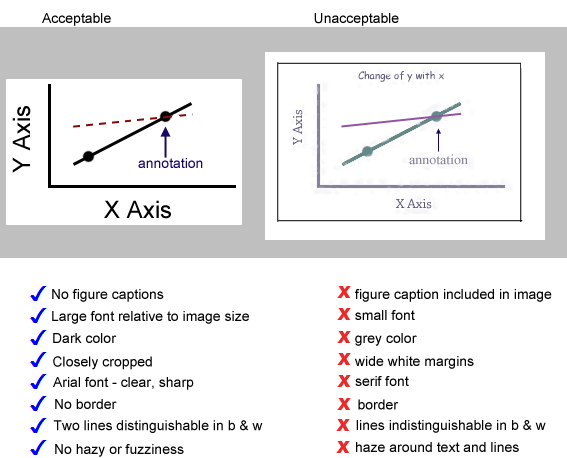
- Ensure all text in a figure is legible on paper when the image is printed 7.5 cm wide.
- Figures must be clear and sharp.
- Use imaging software (Excel does not export graphs well).
- Figures must be in .GIF, .PNG, or .JPG formats.
- For photos or images with gradients of color use JPG.
- For images with flat colors use GIF or PNG.
- Figures may be up to 300 ppi and no wider than 2000 pixels (unless given explicit permission by the managing editor).
- The image will be printed 7.5 cm wide (complex figures may be printed at 16cm) – text should be legible, clear, and sharp at that size. Print your figure at 7.5 cm; is it legible, clear, and sharp?
- Font must be large, legible, and sans serif; arial font is best.
- Use a white background.
- Do not include a title or caption information in the figure. That information is entered elsewhere.
- Initial upper case letters are preferred except where SI requires lower case letters for unit abbreviations (e.g., dbh, ln).
- Do not include a border around your figures.
- Color figures are encouraged. Please verify they will print well in black-and-white (and that color selection would be distinguishable to people who are red-green color-blind).
- Use shaded or hatched bars in preference to color or black ones.
- Use italic lettering for single-letter variables, constants, and scientific names in illustrations to make them consistent with the text.
- Use bar graphs in preference to pie charts.
- If your figures depict recognizable individuals, a signed Consent and Release for Use of Likeness is required (see Copyright and Permissions, below).
Examples of figures:
Appendices
Appendices are neither copy-edited nor formatted prior to publication so authors must ensure that their appendix is formatted correctly and references to appendices in the body of the manuscript are clear.
- Appendices containing text, tables, and/or figures must be uploaded as PDFs, and formatted according to the journal’s style.
- The top margin of the appendix must be 4 cm.
- Enter all title and caption information when asked during the submission process, and upload each appendix as a separate file.
Other appendices
Excel or other database files are acceptable as appendices. Captions should describe the attachment fully (by content, file format, usage, software required to run them, etc.) and are uploaded separately during the submission process.
Multimedia appendices (sound or video files) should be uploaded to an external site (such as YouTube), and a hyperlink to the video can be provided in a PDF appendix file.
Data and Code Archive
Ecology and Society invites authors to make available all relevant data and code underlying the findings described in your manuscript available.
Data can be qualitative or quantitative, collected via physical measurements, surveys, interviews, observations, or other forms of data collection. When we ask for data availability, we do not refer to raw data, but data that is anonymized to protect study participants.
Code refers to computer code of computer models as well as scripts for (statistical) data analysis. The reason for this is to improve the quality of the manuscripts and facilitate the increasing requests from research funders to share and archive research data and code. As part of the submission of the manuscript, the data and code must be made available to editors and peer reviewers for the purposes of evaluating the manuscript by providing a code and data availability statement. Upon acceptance of the paper and as part of the publication, the authors provide a data and code availability statement, which specifies that the data and code are deposited publicly and lists the name(s) of archives along with digital object identifiers or URLs for the relevant deposits.
Human subjects: With respect to data from human subjects, we ask that you forward only information that was approved by the institutional ethics review committee that approved the research study. We also ask you to provide information identifying the institutional approval for the human subjects research.
Examples of recommended public archives include Open Science Framework, Dryad, Zenodo, Figshare, and CoMSES.
Below, find templates you can use as a starting point for your statement. Note that the statement will be published with the article.
| Availability of data and/or code | Template for data and code availability statement |
|---|---|
| Data/code openly available in a public repository that issues datasets with DOIs | The data and code that support the findings of this study are openly available in [repository name e.g., “figshare”] at https://doi.org/[doi], reference number [reference number]. Ethical approval for this research study was granted by [organization and approval number]. |
| Data/code openly available in a public repository that does not issue DOIs | The data and code that support the findings of this study are openly available in [repository name] at [URL], reference number [reference number]. Ethical approval for this research study was granted by [organization and approval number]. |
| Data/code derived from public domain resources | The data and code that support the findings of this study are available in [repository name] at [URL/DOI], reference number [reference number]. These data and code were derived from the following resources available in the public domain: [list resources and URLs] |
| Data/code available on request because of privacy/ethical restrictions | The data and code that support the findings of this study are available on request from the corresponding author, [initials]. None of the data and code are publicly available because of [restrictions e.g., they contain information that could compromise the privacy of research participants]. Ethical approval for this research study was granted by [organization and approval number]. (Provide an explanation in the letter to the editors). |
| Data/code sharing not applicable | Data/code sharing is not applicable to this article because no data and code were analyzed in this study. |
All items required
- This work has not been published elsewhere, nor is it being considered for publication by another journal. If either of these conditions apply, provide complete details in a cover letter (below) to the editors. Failure to notify the editors is grounds for rejection.
- I understand that Resilience Alliance is not for profit and charges a publication fee to cover costs. The base fee is $975/manuscript. (Note: the base article fee will increase to $1100 USD for all Ecology and Society papers submitted on or after 1 January 2024. An annual increase of approximately 3% will take effect on the first day of the year beginning on 1 January 2025 and yearly thereafter.)
*Authors submitting to a Special Feature may have their fees covered by a separate funding source. Please make sure you know whether your fees are covered.
Waivers may be given but must be granted before submission. (see waiver policy) - I understand that a manuscript longer than 5000 words will be subject to additional charges.
- The use of figures and tables that have been published elsewhere is strongly discouraged. If the use of such material simply cannot be avoided, the author MUST
- declare in a cover letter that such material is submitted
- receive written permission from the original publisher to use the materials in perpetuity (that is, without any time limit). You must submit the completed form after your article is accepted for publication.
- The text follows the formatting requirements outlined in the Author Guidelines.
- The text of the paper and tables are in Rich Text Format (RTF). The body of the manuscript has no embedded figures, equations, or tables.
- Equations and figures, if present, are correctly referenced in the body of the paper. (Have individual image files of the equations and figures ready for upload.)
- I have checked with my coauthors about their names and affiliations. I understand that they will not be changed after publication.
- If the work involves human subjects, the author certifies that the work was done with prior approval for human subjects research by an institutional review board (IRB) or equivalent ethics committee(s). The author certifies that the work followed ethical practices designated by either an IRB or ethics committee. If requested from the journal, the author will present documentation from the review board or ethics committee confirming approval of the research. Otherwise, the author certifies that the work did not involve human subjects.
Permission to Use Copyright Protected Material
If, in your submission, you include any material created or published by someone else you must get permission from the copyright holder. Most publishers have their own forms. Once you have received permission from the copyright holder please send a copy to jrnls@resalliance.org (include your manuscript number in the subject line). If there is a fee involved please also send a copy of your receipt as proof of payment.
If the copyright holder does not have their own permission forms please download and complete this form, have the copyright owner sign it, and return it to us.
Consent and Release for Use of Likeness
If you must include images of recognizable people a Consent and Release for Use of Likeness is required (form). Send a copy of the signed agreement to jrnls@resalliance.org.